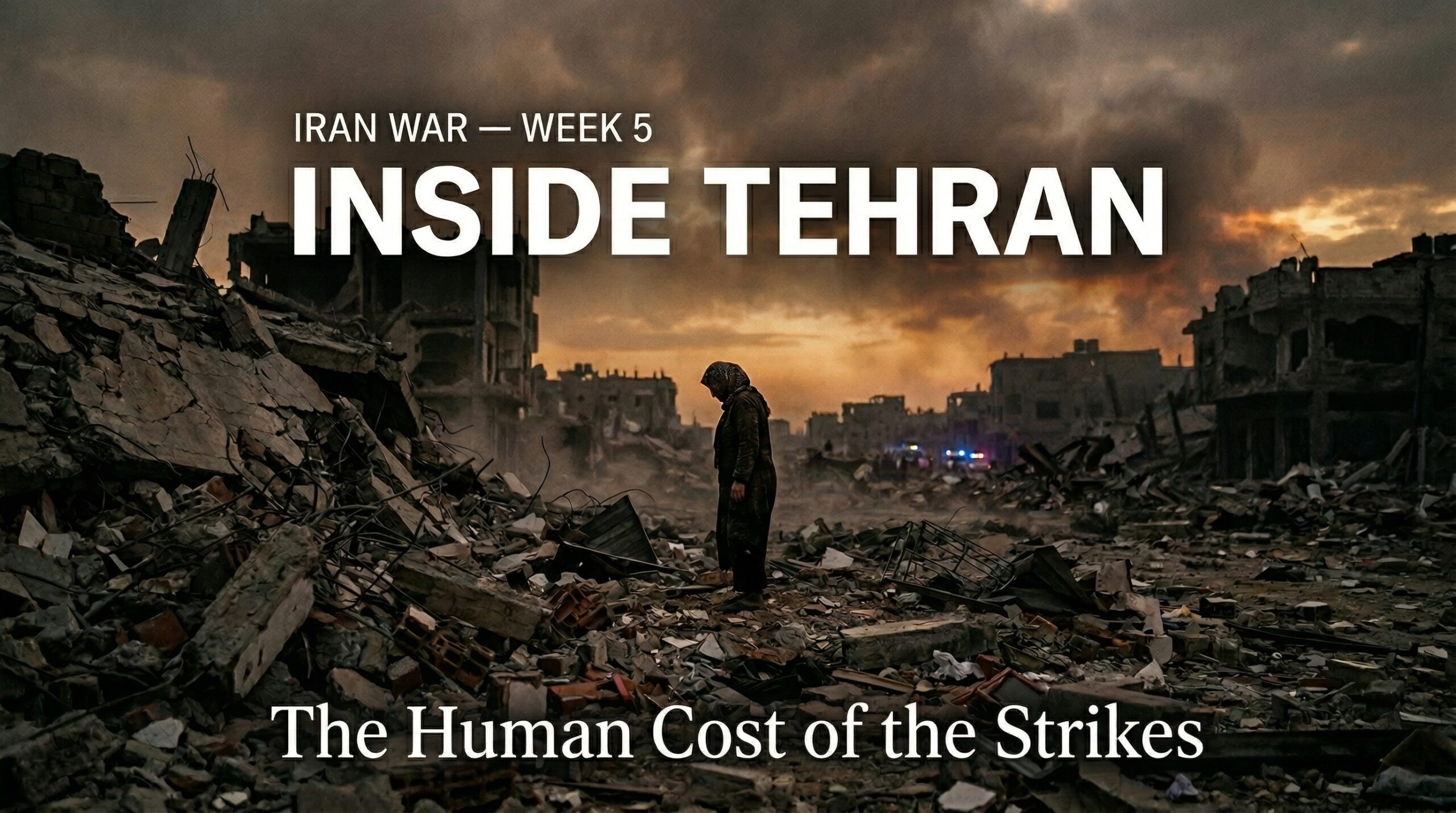
Inside Tehran: The Human Cost of the Iran War
More than 10,000 US strikes. Thousands more from Israel. And a mother waiting three days in the rubble for news of her daughter.
The Iran war has entered its fifth week, and for the first time, journalists have gained rare access inside Tehran to document what the bombing campaign looks like on the ground. What they found cuts through the official narratives on both sides: precision strikes hitting legitimate military targets, yes — but blast zones far wider than the targets themselves, residential buildings obliterated, and civilians paying the price in neighborhoods they’ve called home for decades.
This isn’t just a story about military strategy or diplomatic brinkmanship. It’s about what modern warfare does to ordinary people, and what it means when the gap between stated objectives and ground-level reality becomes impossible to ignore. From the rubble of eastern Tehran to the G7 meeting rooms of Paris, here’s a clear-eyed look at where the Iran war stands right now — and why the road to any resolution remains extraordinarily difficult.
What the Strikes on Tehran Actually Look Like
The Resalat neighborhood in eastern Tehran didn’t make international headlines the day it was bombed. But three days after the strike, a grieving mother was still waiting amid the rubble for news of her daughter — afraid of the dark, the woman said, and now buried under it.
Israeli forces told the BBC they were targeting a Basij compound — a militia unit operating under Iran’s Revolutionary Guard. That compound was confirmed to exist in the area. But on the same day, three other residential buildings in immediate proximity were struck in quick succession. Satellite imagery taken in the aftermath shows all four structures completely obliterated.
The damage radius tells a particularly stark story. Apartments up to 65 meters from the target were heavily damaged. Residents reported 40 people killed. Military experts who reviewed the evidence said the destruction was consistent with a Mark 80 series bomb — a 2,000-pound munition that, even when equipped with precision guidance systems, generates a blast zone far wider than any single building.
38 Police Stations and Basij Bases: A Pattern Across the City
Resalat isn’t an isolated incident. The BBC identified 38 police stations and Basij bases struck in Tehran alone, the vast majority of them situated in densely populated residential areas. A second documented strike on Nilafar Square killed 20 people at a police station; mapping of that blast zone showed the same pattern — wide damage extending well beyond the intended target.
The Israeli Defense Forces maintain that all strikes are directed at lawful military objectives in accordance with international law. The US and Israel have also framed the campaign in explicitly political terms, describing the targeting of these militia bases as preparation for an Iranian popular uprising — an invitation for Iranian citizens to “take over your government,” with the warning that this may be “your only chance for generations.”
Whether or not that framing reflects a realistic strategic outcome is a separate question. What’s documented is the physical reality on the ground: buildings used by the Basij and adjacent civilian structures sharing the same blast radius, in neighborhoods that were residential long before they became militarized.
Rubio’s Two-Week Timeline and What It Assumes
Speaking at a G7 foreign ministers meeting in Paris, US Secretary of State Marco Rubio projected a striking degree of confidence. The war’s objectives, he said, could be achieved within a couple of weeks — destroying Iran’s navy, air force, and missile launch infrastructure to a degree that would prevent the country from ever using those assets as cover for a nuclear program.
“We are ahead of schedule on most of them,” Rubio said, adding that ground troops would not be required to complete the mission.
That confidence may be premature. Iran still controls the Strait of Hormuz — the narrow waterway through which roughly one-fifth of the world’s oil flows — and has announced plans to charge tolls on international shipping passing through it. That single leverage point is significant enough that the US has paused attacks on Iranian civilian energy infrastructure specifically to create space for negotiations.
A two-week timeline for achieving durable strategic objectives assumes Iranian capitulation that, so far, hasn’t materialized.
The 15-Point Plan vs. the Five-Point Plan: A Gap That’s Hard to Bridge
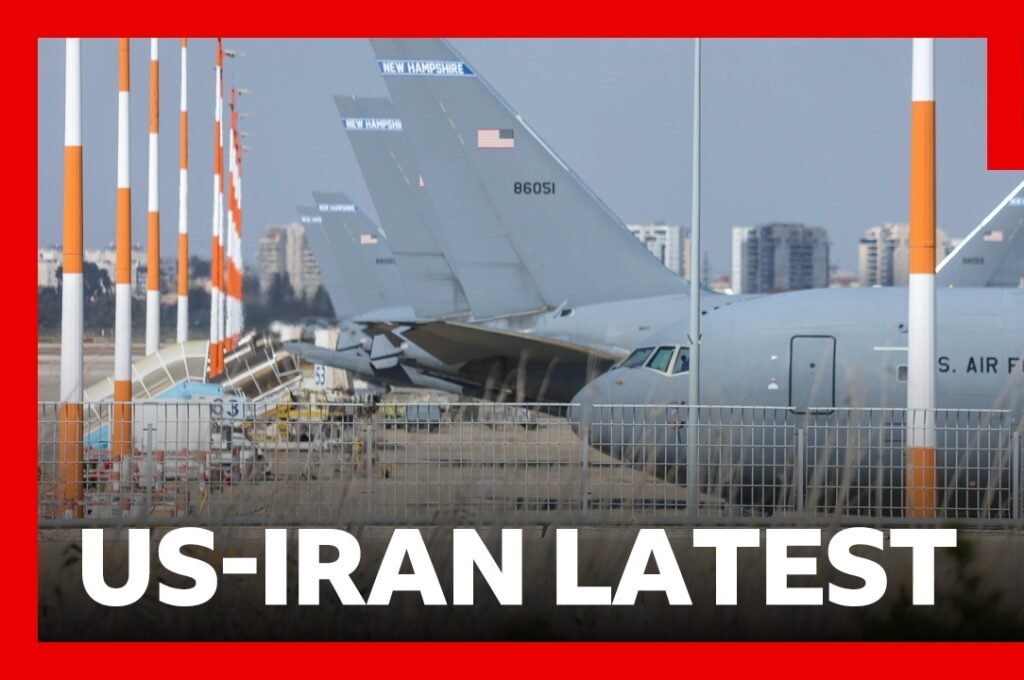
This week, the US reportedly submitted a 15-point framework to Iran, proposing a 30-day ceasefire as the basis for talks. The American position includes restrictions on Iran’s nuclear program, the closure of nuclear facilities, access for UN inspectors, limits on ballistic missile development, and an end to Iranian support for regional militia groups. In exchange, Iran would receive sanctions relief and assistance for its civilian nuclear energy sector.
Iran’s counter-proposal looks nothing like the American framework. Tehran is asking for:
- A complete halt to all US and Israeli military strikes
- Formal guarantees against future aggression
- Compensation for war damage
- International recognition of Iranian sovereignty over the Strait of Hormuz
- Discussion of the closure of US military bases in the region
These aren’t negotiating positions that are close and need fine-tuning. They represent fundamentally different visions of what a post-war Middle East looks like. One side sees the conflict as leverage to permanently curtail Iranian power. The other sees it as an injustice requiring restitution and international recognition of its rights.
And complicating everything further is Israel — a third party with its own objectives. Israeli forces have reportedly struck Iranian steel and nuclear sites, and Israeli troops entered Lebanon to engage Hezbollah fighters. Whatever framework Washington eventually proposes, it cannot bind an Israeli government pursuing its own strategic calculus.
The Strait of Hormuz: The Leverage Point Everything Hinges On
President Trump has publicly insisted that Iran must reopen the Strait of Hormuz to international shipping, free of tolls or interference. G7 foreign ministers in Paris echoed that demand, calling for the immediate restoration of safe and toll-free navigation through the waterway.
Iran’s position is that it has a natural and legal right to sovereignty over the Strait. That claim is contested under international law, but the practical reality is simpler: Iran’s geography gives it the ability to disrupt traffic through the Strait regardless of what any international body says about its legal right to do so.
As long as that leverage remains intact, Iran has a significant bargaining chip — one that keeps the US from simply dictating terms, regardless of military superiority in the air. The pause on energy strikes exists precisely because Washington recognizes this. And while the Iranian port of Bandar Abbas burns under the weight of the conflict, the Strait itself remains the thread that ties economic pressure to diplomatic possibility.
Key Takeaways
- The bombing of Tehran has produced documented civilian casualties in residential neighborhoods adjacent to confirmed military targets, with blast zones far wider than individual strike sites.
- The US and Israel have struck 38 police stations and Basij bases in Tehran alone, framing the campaign as preparation for an Iranian popular uprising.
- Secretary Rubio’s prediction of a two-week resolution assumes a speed of Iranian capitulation not yet supported by events on the ground.
- The US 15-point peace proposal and Iran’s 5-point counter-proposal reflect positions so far apart that genuine near-term resolution looks unlikely.
- Control of the Strait of Hormuz remains Iran’s most powerful leverage point — and the primary reason the US has paused strikes on civilian energy infrastructure to allow talks.
Conclusion: The Distance Between Victory and Resolution
Five weeks in, the Iran war has produced undeniable military results for the US and Israel. Iranian air force assets, naval vessels, and missile infrastructure have been degraded. But military success and strategic resolution are different things — and the human cost of the campaign, now visible in the rubble of Tehran’s residential neighborhoods, raises hard questions about what “winning” actually means.
The diplomatic gap is vast. The leverage is mutual. And the Iranian government, having survived this long under sustained bombardment, is not behaving like a regime on the verge of collapse.
If you found this analysis useful, share it with someone trying to make sense of the headlines. And if you have questions about what a realistic diplomatic path forward might look like, drop them in the comments — this story is far from over.