WHAT YOU NEED TO KNOW
While you weren’t looking, the global AI landscape completely flipped. China’s open source ai models are now beating GPT-5 in real-world tasks (81.4% vs 75% success rate), Meta just spent $2 billion on Chinese AI tech while simultaneously fleeing China, and humanoid robots are performing at concerts in Beijing. Meanwhile, experts predict 2026 will be the year AI stops being vaporware and starts actually working. This isn’t speculation—it’s happening right now, and it’s going to change how you use technology forever.
The Opening Hook
I need you to stop what you’re doing and pay attention to something happening right now.
While tech Twitter obsesses over OpenAI’s latest model and Sam Altman’s congressional testimony, a quiet revolution has been unfolding. A Chinese investment firm—not a tech giant, just a regular investment company—just released an AI model that fixes real software bugs better than both Claude and GPT-5. And they didn’t charge a penny for it.
The kicker? This isn’t an isolated incident. It’s part of a coordinated pattern that’s about to reshape everything you think you know about artificial intelligence.

The Geopolitical Earthquake Nobody Saw Coming
Meta’s $2 Billion Paradox
Here’s where things get weird—and fascinating.
Meta just acquired an AI company called Manus for over $2 billion. The technology is Chinese. The performance benchmarks show it beating OpenAI by more than 10 points. But here’s the twist that should make you sit up straight: Meta is aggressively ripping this technology out of China faster than you can say “national security.”
They’re moving operations to Singapore. Ensuring zero Chinese ownership post-acquisition. And planning to integrate this Chinese-developed AI into Instagram, WhatsApp, and Facebook—the platforms you probably used today.
What does this tell us? The technology is so good that Meta can’t ignore it. But the geopolitical tensions are so intense that they can’t be seen working with China.
This is your first signal that something fundamental has shifted.
Adobe’s Defensive Play
Meanwhile in the US, Adobe just did something equally revealing. They partnered with their competitor Runway—whose Gen 4.5 model currently holds the #1 spot for AI video generation.
Why would Adobe partner with a competitor? Because they’re terrified you’ll leave their ecosystem.
The partnership allows Adobe users to generate AI video clips within Firefly and edit them in Premiere Pro without ever opening another app. It’s a defensive moat disguised as innovation.
The underlying message: The AI wars aren’t about who builds the best model anymore. They’re about who can keep you trapped in their ecosystem.
The Open-Source Uprising That Changes Everything
Let me hit you with some numbers that should make every enterprise software CEO sweat.
iQuest Coder: The Investment Firm’s Side Project
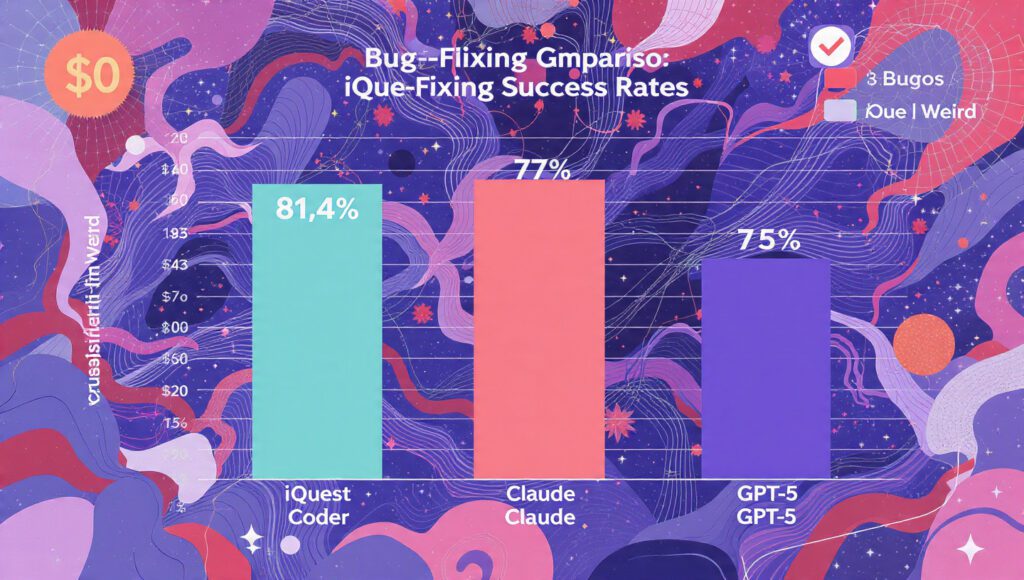
A Chinese investment firm—people whose job is to invest money, not write code—released an open source ai model called iQuest Coder.
Here’s its performance:
- 81.4% success rate at fixing real software bugs
- Claude: 77%
- GPT-5: 75%
Read that again. An investment firm’s side project is outperforming the flagship models from Anthropic and OpenAI. And it’s completely free.
DeepSeek’s Architectural Breakthrough
But wait—there’s more that’ll blow your mind.
Researchers at DeepSeek published a paper on something called “manifold constrained hyperconnections.” I know that sounds like technobabble, but here’s what it actually means for you:
They figured out how to make AI think in parallel—like having multiple lanes of thought running simultaneously—without the system crashing.
The result? Thinking power increased 4X for only a 7% cost increase.
Let me put that in perspective: Imagine if your brain suddenly became four times smarter, but you only needed 7% more coffee to power it. That’s the efficiency breakthrough we’re talking about.
This isn’t about making AI bigger. It’s about making it smarter and cheaper.
Why This Matters to You
Here’s where this gets personal.
Right now, you’re probably paying $20-60/month for AI subscriptions. ChatGPT Plus. Claude Pro. Maybe Midjourney. These companies have trained you to believe that cutting-edge AI requires a subscription.
But what happens when open-source models match or beat these paid services?
The answer: The same thing that happened to encyclopedias when Wikipedia launched. The same thing that happened to taxis when Uber arrived. The same thing that happened to hotels when Airbnb appeared.
Disruption doesn’t announce itself with trumpets. It arrives quietly, performs better, costs less, and suddenly everyone wonders why they were paying so much.
The Robotics Reality Check
Let’s talk about something that sounds like science fiction but is happening right now in China.
500 Robots Already Shipped. 10,000 Coming by 2026.
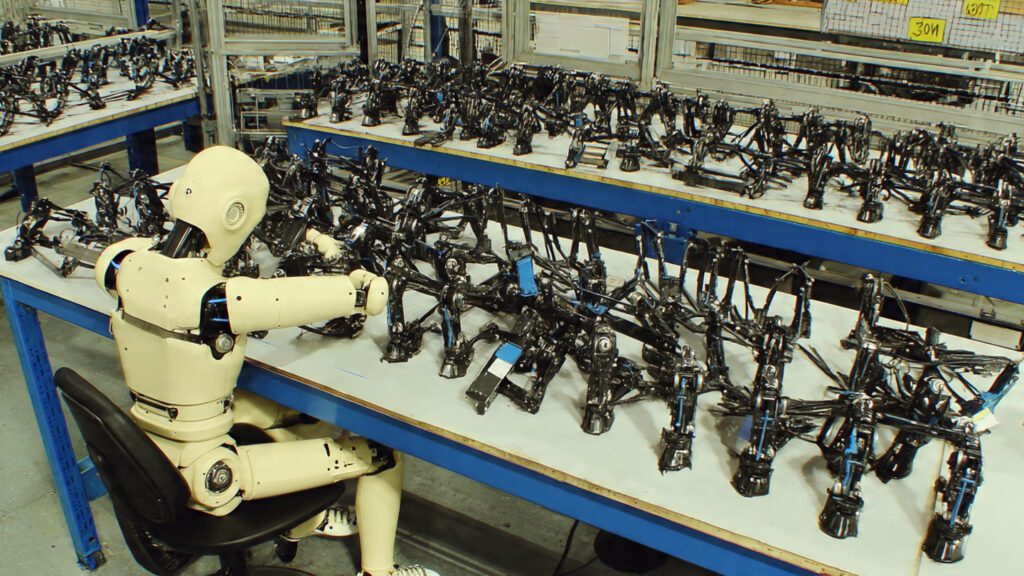
A company called UB has already deployed 500 humanoid robots in factories. Not prototypes. Not demos. Actually working, actually productive robots.
Their target for 2026? 10,000 units.
But here’s what’s actually wild: China isn’t just building robots. They’re building the infrastructure for robots.
The Chinese government established a committee to write the global rulebook for robot safety and hardware standards. They’re robots at concerts and New Year’s galas to familiarize the population with the technology. They’re treating humanoid robots like they’re already a normal part of society.
At CES, the world’s biggest tech show: 20 out of 34 humanoid robot exhibitors are Chinese. Only 5 are American.
What This Actually Means
I know what you’re thinking: “Cool robots, but how does this affect my life?”
Here’s how.
Every technology follows the same adoption curve: Expensive novelty → Industrial application → Consumer ubiquity.
Computers went through this. Smartphones went through this. EVs are going through this right now.
Humanoid robots are in the industrial application phase. Which means consumer ubiquity is 5-10 years away.
Think about what having a $10,000 humanoid robot in your home means:
- Elderly care without nursing homes
- Household chores while you work
- Child supervision with infinite patience
- Physical labor without physical strain
China is positioning itself to be the “factory of the world” for this next revolution. Just like they did with smartphones. Just like they did with solar panels. Just like they did with batteries.
The pattern is clear. The question is whether you’re paying attention.
The Tools That Are Actually Changing Lives Right Now
Enough macro trends. Let’s get tactical.
I tested 10 AI tools that launched recently. Here are the three that genuinely changed how I work (and seven others worth knowing about).
The Game-Changers
1. Starkly – The App Builder That Actually Works
I gave Starkly this prompt: “Build me a client intake form that saves to a database and sends me email notifications.”
Time elapsed: 4 minutes.
Result: A fully functional web app with a custom database, email integration, and a clean interface.
I’m not a coder. I didn’t write a single line of code. This is the “utility over novelty” shift experts are talking about.
Who needs this: Freelancers, small business owners, anyone who’s ever paid $5,000 for custom software.
2. Heap – Brand Monitoring in the AI Age
Here’s a problem you didn’t know you had: When someone asks ChatGPT or Claude for recommendations in your industry, is your brand being mentioned?
Heap monitors this using 33 different metrics. It tells you how often AIs mention your brand, in what context, and whether the sentiment is positive or negative.
Why this matters: SEO is dying. AI answer engines are rising. If you’re not in the AI’s “recommendation set,” you’re invisible.
3. Vogant – Voice Agents Without the Robotic Cringe
I’ve tested a dozen AI voice agent builders. They all sound like someone reading a script at gunpoint.
Vogant is different. It uses no-code building blocks to create AI phone agents that actually sound human. Natural pauses. Contextual responses. Voice inflection that doesn’t make you want to hang up immediately.
Use case: Customer support, appointment scheduling, lead qualification—anything where you’re currently paying someone $15/hour to read from a script.
The Worth-Knowing-About Tools
- Jetty: AI health companion for chronic illness symptom tracking (finally, health tech that doesn’t require a PhD to use)
- Lip Dub: High-quality video translation with lip-syncing (make your content work in 20 languages)
- Keep Mind: Converts documents into spaced repetition study aids (learn anything 3X faster)
- Crash: Validates business ideas using 33 financial metrics (stops you from wasting 6 months on a bad idea)
- Samira: Single subscription for text, image, video, and audio AI (one bill instead of five)
- Migma: Generates on-brand emails by analyzing your website (never write “Following up…” again)
- Audioscribe: Transcription with speaker labels (turns 1-hour meetings into 2-minute summaries)
The 2026 Prediction That Keeps Me Up at Night
Microsoft’s CEO Satya Nadella said something recently that perfectly captures where we are:
“We’re in a model overhang.”
Translation: AI is already more capable than we know how to use it.
Think about that. The technology is ready. The infrastructure is ready. The models work. We’re the bottleneck.
What This Means for 2026
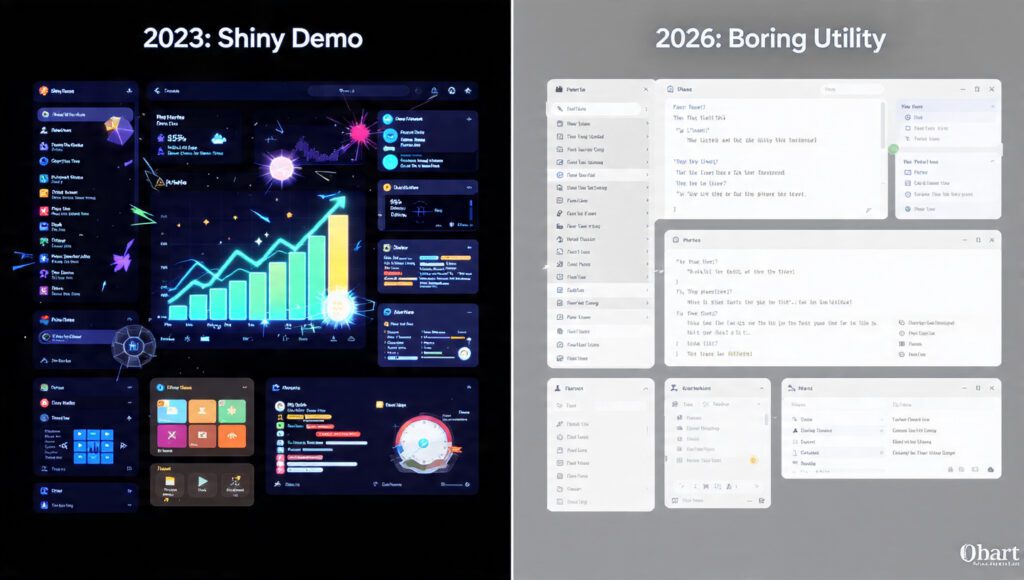
The shift from hype to utility is happening now.
For three years, AI has been about impressive demos:
- “Look, it can write poetry!”
- “Look, it can make images!”
- “Look, it can pass the bar exam!”
2026 is different. 2026 is about:
- AI that books your dentist appointment without you thinking about it
- AI that monitors your brand mentions across the internet automatically
- AI that fixes bugs in your code while you sleep
- AI that translates your videos into 20 languages with perfect lip-sync
The demos are over. The utility era begins.
The Authenticity Paradox
Instagram’s Adam Mosseri made another prediction that’s equally fascinating:
As AI-generated content becomes perfect, “raw and messy” human content becomes a luxury good.
Think about what this means. Right now, polished = valuable. By 2026, polished = suspicious.
The future of social media might be Instagram adding “Verified Human Content” stamps to prove you actually took that photo yourself.
Imagine showing your grandkids that you were part of the last generation that created everything themselves. That’ll be the flex.
Your Action Plan: What to Do Right Now
Okay, you’ve made it this far. You understand the landscape is shifting. Now what?
Quick Wins (Do These This Week)
1. Audit Your AI Spending
List every AI subscription you’re paying for. Now ask: Could an open-source alternative do 80% of the job for free?
For most people, the answer is yes for at least 2-3 subscriptions.
Potential savings: $40-80/month ($480-960/year)
2. Test One Tool From the List Above
Pick the tool that solves your biggest pain point. Give it 30 minutes. If it saves you even one hour this month, it’s worth it.
My recommendation: Start with Starkly if you’re a business owner, Heap if you’re in marketing, or Vogant if you’re drowning in customer calls.
3. Set Up an AI Brand Monitor
Use Heap or a similar tool to track how often AI models mention your brand. Do this before your competitors do.
Why now: Being in the AI recommendation set is the new “ranking #1 on Google.” Early adopters win.
Medium-Term Strategy (Next 3 Months)
1. Learn Prompt Engineering (The Real Skill)
The most valuable skill in 2026 won’t be coding. It’ll be knowing how to get AI to do exactly what you want.
Framework: Use the “Context + Task + Constraints + Format” structure:
- Context: “You’re an expert copywriter…”
- Task: “Write an email that…”
- Constraints: “Keep it under 150 words, friendly tone…”
- Format: “Use bullet points for the main benefits”
2. Experiment With Open Source Ai Models
Spend one Saturday testing open-source alternatives to your paid tools. Many are now comparable in quality.
Resources to explore:
- Hugging Face (model repository)
- LM Studio (run models locally)
- Ollama (simplified local AI)
3. Build One AI-First Process
Take one repetitive task in your work and rebuild it entirely around AI.
Examples:
- Content creation workflow using AI research + editing
- Customer support using AI triage + human escalation
- Data analysis using AI summarization + human interpretation
Long-Term Positioning (Next 12 Months)
1. Develop “AI Fluency” as a Core Competency
Learn enough about how AI works to have intelligent conversations about it. You don’t need to understand transformers and attention mechanisms, but you should understand:
- What AI is good at (pattern matching, repetition, summarization)
- What AI is bad at (true creativity, ethical reasoning, contextual judgment)
- How to evaluate AI output critically
2. Build Your “Verified Human” Portfolio
Start documenting your authentic, human-created work now. In three years, being able to prove you created something yourself will be valuable.
3. Position for the Robotics Wave
If you’re in manufacturing, logistics, healthcare, or elder care, start planning for how humanoid robots will impact your industry by 2030.
Investment thesis: Companies building robot infrastructure (charging stations, maintenance networks, training facilities) will be the next “EV charging station” opportunity.
The Question You Should Be Asking
Here’s what I want you to think about:
If AI is getting better and cheaper this fast, what becomes more valuable, not less?
My answer:
- Taste and judgment (AI can generate 1,000 options; you still need to pick the right one)
- Strategic thinking (AI can optimize tactics; you still need to set direction)
- Human connection (AI can scale communication; you still need to build trust)
- Ethical reasoning (AI can analyze scenarios; you still need to decide what’s right)
The future isn’t about competing with AI. It’s about being the human that AI amplifies.
The Bottom Line
Let me bring this home.
We’re living through a rare moment where the entire stack is being rebuilt. Not improved. Rebuilt.
- The dominant players are being challenged by open-source alternatives
- The geopolitics of technology is shifting East
- The applications are moving from demos to utility
- The cost of intelligence is dropping toward zero
This creates two categories of people:
- Those who see it happening and position themselves accordingly
- Those who wake up in 18 months wondering what happened
I wrote this 4,000-word guide because I want you in category one.
The tools are here. The knowledge is available. The opportunity is massive.
The only question is: What are you going to do about it?
What Happens Next
If you found this valuable, here’s what to do:
- Bookmark this post – You’ll want to reference these tools and strategies as you implement them
- Test one tool this week – Knowledge without action is just entertainment
- Share this with one person who needs to read it – The people who adapt first help the most people
- Come back in 30 days – I’m tracking these trends weekly and will update you on what actually matters (not just what’s getting hyped)
Want to stay ahead of the curve? Drop your email below and I’ll send you a monthly “AI Reality Check” – what’s actually working, what’s just noise, and what you should be paying attention to.
Because in 2026, the future won’t wait for you to catch up.
The revolution is here. Are you ready?