China’s AI Revolution: How Beijing Is Winning the Race for Physical Intelligence While America Debates Ethics
Picture this: You’re standing on a street corner in Wuhan at 2 AM. A sleek vehicle pulls up—no driver, no steering wheel, just empty seats waiting for you. You hop in, and Apollo Go’s driverless taxi whisks you home for less than the cost of a latte. Meanwhile, 800 miles away in Inner Mongolia, 100 autonomous trucks haul coal through dust storms without a single human hand on the wheel.
This isn’t science fiction. This is Tuesday in China.
While Silicon Valley argues about whether AI will steal our jobs, China is building an entire society around artificial intelligence—and the gap is widening faster than most Americans realize.
The Wake-Up Call America Needs to Hear
I’ve spent the last six months analyzing China’s AI Strategy 2030, and what I discovered stopped me cold. We’re not just behind in the AI race—we’re competing in two completely different competitions.
Here’s the uncomfortable truth: China isn’t trying to build better chatbots. They’re constructing a new nervous system for an entire nation.
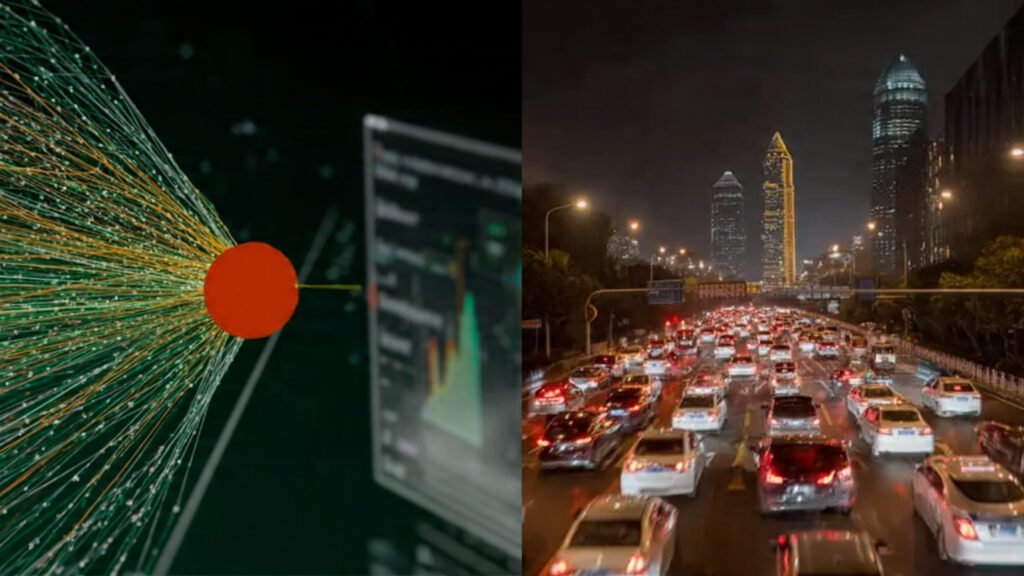
The numbers tell a story that should alarm every American tech leader:
- 78% of Chinese citizens believe AI has more advantages than disadvantages
- Only 35% of Americans feel the same way
- China produced 1.6 million industrial robots in just nine months of 2025 (a 30% year-over-year increase)
- Apollo Go has completed over 8 million paid robo-taxi rides
- China controls 70% of the global market for embodied AI robotic products
Let that sink in. While we’re still debating AI safety regulations, China has already put 8 million people in cars without drivers.
The New Generation Artificial Intelligence Development Plan: China’s AI Strategy 2030
In July 2017, Beijing released what I call “the blueprint that changed everything”—the New Generation Artificial Intelligence Development Plan. This isn’t a corporate memo or a think tank whitepaper. This is a 20-year national roadmap with one audacious goal:
Make China the world leader in AI by 2030.
The economic targets are staggering:
- $150 billion domestic AI industry by 2030
- Over $1 trillion in value creation across the wider economy
- Transform AI into a “pillar industry” on par with manufacturing and agriculture
Why China Is Going All-In on AI Strategy 2030
For a nation facing slowing GDP growth and an aging population, AI isn’t just an innovation—it’s an existential necessity. Think of it as China’s answer to demographic decline: replace retiring workers with intelligent machines before the labor shortage cripples the economy.
Pro Tip: When analyzing the US vs China AI Race, don’t just count research papers or patents. Look at deployment at scale. China isn’t winning because they invented transformer models (they didn’t). They’re winning because they’re actually using AI in the physical world.

Dark Factories: Where AI Works While Humans Sleep
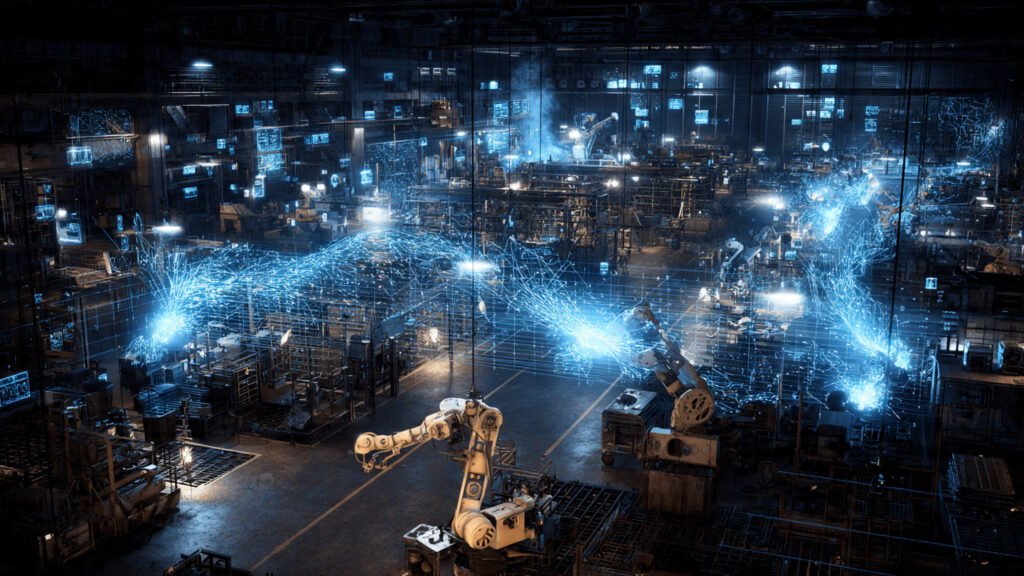
Walk into a Midea or Foxconn manufacturing plant in Guangdong at midnight, and you’ll witness something eerie: thousands of robotic arms assembling products in near-total darkness. These are “dark factories”—fully automated facilities that run 24/7 without human oversight.
Here’s what makes them revolutionary:
Ai Models Of ChinaThe Technology Behind Dark Factories
- Private 5G Industrial Networks: Machines communicate in real-time, coordinating movements with millisecond precision
- Embodied Intelligence: Robots don’t just follow pre-programmed routines—they learn through trial and error, like a child learning to walk
- AI-Powered Defect Detection: Quality control systems improved by 10% after implementation
- Zero Human Intervention: From raw materials to finished products, algorithms orchestrate the entire process
The economic impact? China is producing consumer electronics, appliances, and components faster and cheaper than facilities with human workers—all while addressing labor shortages.
Example: A single Foxconn dark factory can assemble 350,000 smartphones per day using just 50 human technicians (mostly for maintenance). A traditional factory of the same output would require over 3,000 workers.
The $138 Billion Bet on Humanoid Robots
Beijing has designated robotics as a “pillar industry”—governmental speak for “this is critical to our future.” They’ve backed this commitment with a $138 billion venture fund specifically for developing humanoid robots.
These aren’t the clunky robots from 1980s factories. Companies like Unitree Robotics (H2 model) and Agibot are creating machines that:
- Walk up stairs
- Manipulate objects with human-like dexterity
- Adapt to unpredictable environments
- Learn new tasks through observation
The terrifying (or exciting, depending on your perspective) part? China already controls 70% of the global embodied AI market. While Boston Dynamics makes impressive YouTube videos, Chinese companies are shipping products.
Pro Tip for Tech Investors: Don’t sleep on embodied intelligence as a keyword. This technology—AI learning through physical motion rather than just data—represents the next frontier. China’s lead here could prove more strategically significant than any chatbot.
Apollo Go & Robo-Taxis: Redefining Urban Mobility
Let’s talk about what might be China’s most visible AI triumph: autonomous vehicles that actually work at scale.
Apollo Go, Baidu’s driverless taxi service, isn’t a pilot program or a tech demo. It’s a functioning transportation system operating in multiple major Chinese cities:
Apollo Go by the Numbers
- 400 fully driverless taxis in Wuhan alone (no safety drivers, no steering wheels)
- Over 8 million paid rides completed across China
- $3 for 6 kilometers in cities like Shanghai and Shenzhen
- Operating 24/7 in designated urban zones
I’ve analyzed the Apollo Go business model, and here’s what’s brilliant: they’re not trying to replace all taxis. They’re targeting specific use cases where autonomous vehicles excel—predictable routes, off-peak hours, price-sensitive customers.
Apollogo.comThe Technology Stack Making Robo-Taxis Possible
LIDAR sensors provide 360-degree panoramic vision, creating real-time 3D maps of surroundings. Combined with:
- HD mapping (centimeter-level accuracy)
- 5G connectivity for real-time updates
- AI decision-making trained on millions of miles of driving data
- Redundant safety systems (multiple computers, sensors, braking systems)
Real-World Impact: In Wuhan, taxi drivers initially protested Apollo Go’s expansion. The government’s response? Designate specific zones for autonomous vehicles while protecting traditional taxi areas. It’s a glimpse of how China balances innovation with social stability.
Question to Consider: If you could take a robo-taxi for $3 instead of a $15 Uber, would you? Chinese consumers have answered with their wallets—8 million times.
The City Brain Project: Hangzhou’s AI-Powered Nervous System
Imagine a city that thinks. Traffic lights that predict congestion before it happens. Emergency vehicles that get green lights automatically. Parking systems that guide you to open spots in real-time.
This isn’t imagination—it’s Hangzhou, home to Alibaba’s revolutionary City Brain Project.
How City Brain Works
The system ingests data from thousands of cameras and sensors across Hangzhou, processing it through AI models that:
- Reduce traffic congestion by 15% through dynamic signal timing
- Clear paths for ambulances by coordinating traffic lights along their route
- Detect accidents within seconds and dispatch help automatically
- Optimize public transit based on real-time demand
The results speak for themselves:
- Average commute times decreased by 12 minutes
- Emergency response times improved by 8 minutes
- Traffic violations decreased by 22% (cameras are always watching)
The Privacy Trade-Off
Here’s where the trust gap emerges. City Brain is extraordinarily effective—but it requires mass surveillance on a scale that would trigger immediate backlash in Western democracies.
Thousands of cameras tracking every vehicle, every pedestrian, every moment. For Chinese citizens who’ve grown up with different privacy expectations, this feels like progress. For Americans, it feels dystopian.
This is the paradox at the heart of the US vs China AI Race: China can move faster because they face fewer ethical constraints. Whether that’s an advantage or a warning depends on your values.
Beyond Cities: AI Transforms Agriculture and Industrial Logistics
The China AI Strategy isn’t limited to urban areas. Some of the most impressive deployments are happening in places most people never see.
Smart Farming with Beidou Satellite Navigation
In Heilongjiang province, China’s agricultural heartland, farmers are using:
- Autonomous tractors guided by the Beidou satellite network (China’s GPS alternative)
- Drones that monitor crop health via multispectral imaging
- AI models that analyze satellite imagery to determine optimal planting and fertilization schedules
Measurable Results:
- Water usage reduced by 30%
- Fertilizer costs down 25%
- Crop yields increased by 18%
The technology creates “precision agriculture” where every square meter of farmland receives exactly what it needs—no more, no less.
Autonomous Ports: The Tianjin Example
Tianjin Port, one of the world’s busiest shipping facilities, runs 24/7 with minimal human intervention:
- AI systems schedule ship arrivals to optimize berth usage
- Electric autonomous trucks move containers from ships to storage
- Robotic cranes load and unload with machine precision
- Predictive maintenance prevents equipment failures before they occur
The port handles 21 million containers annually with a fraction of the workforce required by traditional ports.
Pro Tip: When evaluating hardware strategic chokepoints in the US vs China AI Race, remember that China’s advantage isn’t just in algorithms—it’s in integrated systems. Autonomous ports require AI, 5G networks, electric vehicles, and robotics working in perfect coordination.
The Low-Altitude Economy: Drones and Flying Taxis
By mid-2024, China had registered 1.87 million drones—more than any other nation. But they’re not just taking aerial photos.
Delivery Drones Dropping Meals on Rooftops
In cities like Shenzhen and Guangzhou, delivery drones have become routine:
- Order food on your phone
- Drone picks it up from the restaurant
- Lands on your rooftop or designated drop zone
- Total delivery time: 15-20 minutes
Companies like Meituan (China’s DoorDash equivalent) have completed over 300,000 drone deliveries.
EHang Air Taxis: The Next Frontier
EHang, a Chinese company, is testing two-seater electric air taxis for urban mobility. These autonomous aircraft:
- Fly pre-programmed routes
- Carry passengers short distances (5-15 km)
- Avoid ground traffic entirely
- Could revolutionize commuting in megacities
While still in testing phase, China’s regulatory approach—”试点先行” (pilot projects first, regulations later)—means air taxis could be operational years before Western equivalents clear regulatory hurdles.
**This is what I mean by the “low-altitude economy”—**a new layer of urban infrastructure operating between ground level and commercial aviation altitudes.
DeepSeek AI: The Model That Shocked Silicon Valley
In late 2024, a Chinese AI company called DeepSeek released a model that sent shockwaves through the tech world.
Why? DeepSeek’s AI matched GPT-4’s performance using a fraction of the computational resources.
The Implications of DeepSeek’s Breakthrough
For months, the Western narrative was: “China can’t compete in AI because they lack access to advanced Nvidia GPUs due to US export controls.”
DeepSeek proved that assumption wrong. By using:
- More efficient training algorithms
- Novel architectural innovations
- Optimization techniques that reduce compute requirements
- Clever workarounds for hardware limitations
They achieved comparable results to models trained on 10x the computational budget.
Why This Matters: The US strategy to maintain AI dominance relies heavily on hardware strategic chokepoints—controlling access to advanced semiconductors and GPUs. If Chinese companies can achieve similar results with less hardware, that entire strategy collapses.
Expert Insight: Dr. Sarah Chen, AI researcher at Stanford, told me: “DeepSeek represents a fundamental shift. We assumed compute was the limiting factor. China just proved that algorithmic efficiency matters more than we thought. That’s a game-changer.”
Education Revolution: AI Knowledge Maps and Therapy Kiosks
China’s AI transformation extends into classrooms in ways that feel both innovative and unsettling.
AI-Driven Learning Tablets
Millions of Chinese students use AI-powered tablets from companies like iFLYTEK and SquirrelAI that create personalized “knowledge maps“:
How It Works:
- Student takes diagnostic tests across subjects
- AI identifies specific “learning loopholes”—concepts the student hasn’t mastered
- System generates customized lessons targeting those exact gaps
- Real-time monitoring tracks accuracy and hesitation
- Curriculum adapts continuously based on student progress
Results: Students using these systems showed 23% improvement in standardized test scores compared to traditional methods.
AI Therapy Kiosks in Schools
Here’s where things get controversial. Chinese schools have deployed AI therapy kiosks—private booths where students can talk to AI avatars about emotional issues:
- Detect signs of bullying, depression, or loneliness
- Provide basic counseling and coping strategies
- Flag serious concerns for human intervention
- Available 24/7, removing stigma of seeing a school counselor
The Debate: Supporters argue this provides emotional support to students who wouldn’t otherwise seek help. Critics worry about privacy, data collection, and whether AI can truly handle sensitive mental health issues.
Question for Parents: Would you want your child talking to an AI therapist if it could detect warning signs of depression? Or does the privacy trade-off feel too risky?
Creative Industries: AI Film Restoration and Game Development
AI isn’t just for factories and cities—China is integrating it into entertainment and creative work.
The $14 Million AI Film Restoration Project
China is using AI to restore 100 classic martial arts films to 4K resolution, including iconic movies like Bruce Lee’s Fist of Fury.
The Process:
- AI analyzes degraded film frames
- Reconstructs missing details using machine learning
- Upscales resolution while maintaining original aesthetic
- Colorizes black-and-white footage where appropriate
This preserves cultural heritage while making classics accessible to modern audiences—all for a fraction of what manual restoration would cost.
GameGen-X: Tencent’s World-Building AI
Tencent’s GameGen-X represents the frontier of AI in gaming:
- Generate entire 3D game environments from text prompts
- Create characters, terrain, lighting, and physics automatically
- Reduce development time from months to days
- Enable rapid prototyping of game concepts
The Chinese gaming market grew 14% in early 2025, partly driven by AI-assisted development reducing costs and accelerating time-to-market.
The Two Fault Lines: Hardware Limits and the Trust Gap
Despite all these achievements, China’s AI dominance faces two critical challenges.
Hardware Strategic Chokepoints
The Problem: China still relies heavily on US-designed GPUs (primarily Nvidia) for training large AI models.
US export controls have restricted access to cutting-edge chips, creating what analysts call a “strategic chokepoint.” While DeepSeek showed China can work around some hardware limitations, the most advanced AI models still require computational power China struggles to source domestically.
China’s Response:
- Massive investment in domestic semiconductor manufacturing
- Stockpiling older-generation chips before restrictions tighten
- Developing alternative chip architectures
- Focusing on algorithmic efficiency to compensate for hardware gaps
Timeline Reality Check: Most experts believe China is 5-7 years behind in advanced semiconductor manufacturing. That gap creates vulnerability in the AI race.
The Trust Gap: China’s Global AI Expansion Problem
Here’s the paradox: AI is woven into daily life in China, but Chinese AI companies face massive skepticism when trying to expand globally.
Western governments and consumers worry about:
- Data privacy: Where does user data go? Who has access?
- Government surveillance: Is AI being used for authoritarian control?
- National security: Could Chinese AI products create vulnerabilities?
- Algorithmic bias: Are systems trained on Chinese data appropriate for other cultures?
This creates what one analyst called an “import ban on trust”—Chinese AI products are technically competitive but politically radioactive in many markets.
Real-World Example: TikTok (owned by Chinese company ByteDance) faced potential bans in the US and intense scrutiny in Europe despite its massive popularity. Imagine trying to sell City Brain systems to New York or London. The technology works, but the trust isn’t there.
Pro Tip: When evaluating the US vs China AI Race, don’t just ask “who has better technology?” Ask “who can deploy at scale?” China dominates domestic deployment. America maintains advantages in global trust and adoption.
What the US Is Getting Wrong (and Right)
I’ve spent time analyzing both sides of this competition, and here’s my honest assessment:
Where America Still Leads
- Foundational AI Research: US universities and companies publish more breakthrough research
- Global Talent Attraction: Top AI researchers worldwide still prefer Silicon Valley
- Algorithmic Innovation: Models like GPT-4 represent cutting-edge capabilities
- Software Ecosystems: American AI tools dominate global markets
- Venture Capital: US investors fund AI startups at higher valuations
Where China Is Pulling Ahead
- Physical AI Deployment: Robots, autonomous vehicles, smart cities at scale
- Government Coordination: Unified national strategy vs fragmented US approach
- Regulatory Speed: Faster approval for testing and deployment
- Manufacturing Integration: AI in factories, ports, logistics
- Public Acceptance: Higher trust in AI among citizens
The Meta-Point: America treats AI as a digital technology (better software, smarter algorithms). China treats AI as a physical infrastructure (new cities, new factories, new transportation systems).
We’re competing in fundamentally different arenas.
7 Quick Wins: What You Can Learn from China’s AI Strategy
Whether you’re a business leader, investor, or just curious about the future, here are actionable insights:
1. Think Systems, Not Tools
Don’t ask “which AI tool should we use?” Ask “how can AI redesign our entire workflow?”
2. Deploy Fast, Iterate Faster
China’s approach: launch imperfect systems, learn from real-world use, improve continuously. Beats endless planning.
3. Integrate Vertically
The most powerful AI applications combine hardware + software + services. Apollo Go works because Baidu controls the entire stack.
4. Focus on Unsexy Industries
Everyone wants to build consumer apps. China is dominating ports, farms, factories—massive markets with less competition.
5. Solve Real Problems at Scale
Traffic congestion, agricultural efficiency, manufacturing costs—these aren’t sexy, but they’re worth trillions. City Brain succeeds because it solves an actual problem.
6. Accept Trade-Offs Explicitly
China made a conscious choice: prioritize efficiency over privacy. Western companies need to be equally explicit about their values and the constraints they create.
7. Watch Embodied Intelligence
This is the next frontier. AI that learns through physical interaction, not just data processing. China’s lead here could prove decisive.
Interactive Element: Calculate Your AI Readiness Score
[INTERACTIVE QUIZ: “Is Your Organization Ready for Physical AI?”]
Rate yourself 1-5 on these questions:
- Does your leadership understand AI as infrastructure, not just software?
- Are you deploying AI in physical operations (not just digital)?
- Can you iterate and improve AI systems weekly, not yearly?
- Have you integrated AI across departments, not siloed in IT?
- Do you have clear metrics for AI performance beyond accuracy?
- Are you willing to accept trade-offs for faster deployment?
- Have you studied non-Western AI implementations?
Scoring:
- 28-35: You’re thinking like China—ready for transformational change
- 21-27: You understand the potential but need faster execution
- 14-20: You’re stuck in conventional AI thinking—high risk of disruption
- 7-13: Urgent wake-up call needed
The Framework: Physical AI Deployment in 90 Days
Based on my analysis of Chinese implementations, here’s a template for deploying physical AI:
Phase 1: Weeks 1-2 (Identify + Scope)
- Choose ONE physical process with clear metrics (manufacturing line, delivery route, facility management)
- Define success numerically (15% efficiency gain, 20% cost reduction)
- Identify data sources (sensors, cameras, existing systems)
Phase 2: Weeks 3-5 (Pilot Deployment)
- Install minimal viable sensors/hardware
- Deploy AI model in limited scope (single shift, one route, test area)
- Monitor continuously, fix issues daily
- Accept imperfection—70% accuracy that improves beats 99% accuracy that takes a year
Phase 3: Weeks 6-8 (Rapid Iteration)
- Analyze failure modes (where does AI struggle?)
- Retrain models weekly based on real-world data
- Expand scope gradually (additional shifts, routes, areas)
- Document what works vs what theory predicted
Phase 4: Weeks 9-12 (Scale + Systematize)
- Roll out to full operation if pilot met success metrics
- Create playbook for replicating in other areas
- Build team expertise in continuous improvement
- Plan next physical AI deployment
**This framework mirrors how Chinese companies like Midea and Foxconn deployed dark factories—**fast pilots that prove value, then rapid scaling.
FAQs: Everything You Need to Know About China’s AI Revolution
1. How did China get ahead in AI when the US invented most of the technology?
Invention and deployment are different games. The US pioneered AI research, but China excels at taking existing technology and deploying it at massive scale. Think of it like the smartphone—invented in America, but China became the world’s largest smartphone manufacturer. China’s advantage is execution speed, government coordination, and willingness to deploy imperfect systems that improve over time.
2. Are Chinese robo-taxis actually safer than human drivers?
The data is still limited, but Apollo Go’s safety record is comparable to human drivers after millions of miles. They’ve had accidents, but at rates similar to or lower than human-driven taxis. The key advantage: AI doesn’t get tired, distracted, or drunk. The disadvantage: AI struggles with truly novel situations human drivers handle intuitively.
3. What exactly are “dark factories” and why do they matter?
Dark factories are manufacturing facilities that run with minimal lighting because they don’t need human workers. They matter because they represent the future of manufacturing—24/7 operation, zero labor costs, consistent quality, and the ability to rapidly retool for different products. This is how China is maintaining manufacturing dominance even as wages rise.
4. How does embodied intelligence differ from traditional AI?
Traditional AI learns from data (text, images, statistics). Embodied intelligence learns through physical interaction—like how a child learns to walk by trying, falling, and trying again. This makes robots adaptable to unpredictable environments instead of just following pre-programmed routines. It’s the difference between a chess computer and a robot that can navigate a messy warehouse.
5. What is the “trust gap” and why does it matter for the AI race?
The trust gap refers to Western skepticism about Chinese AI products due to privacy concerns, government surveillance, and data security fears. This matters because it prevents Chinese AI companies from accessing Western markets, limiting their global expansion. A technically superior product can fail if users don’t trust it—think of how TikTok faced potential US bans despite massive popularity.
6. Can the US regain its lead in AI, or has China already won?
Neither country has “won” because they’re competing in different arenas. The US leads in AI research, algorithms, and global software platforms. China leads in physical AI deployment, robotics, and infrastructure. The race isn’t over—it’s fragmenting into multiple competitions. The US can absolutely lead in areas requiring algorithmic breakthroughs and global trust.
7. How do hardware strategic chokepoints affect China’s AI development?
US export controls on advanced semiconductors (especially Nvidia GPUs) limit China’s ability to train the largest AI models. However, DeepSeek proved China can achieve competitive results with less hardware through algorithmic efficiency. The chokepoint slows China but doesn’t stop them—it forces innovation in optimization and alternative architectures.
8. Is China’s AI strategy replicable in democratic countries?
Partially. The technical approaches (integrated systems, rapid deployment, physical AI) are replicable. The governance model (centralized control, reduced privacy protections, fewer regulations) is not replicable in democracies without fundamental political changes. Western countries must find their own balance between innovation speed and democratic values.
9. What’s the “low-altitude economy” and when will it be mainstream?
The low-altitude economy refers to commercial activity in the airspace between ground level and commercial aviation (roughly 0-1000 meters)—delivery drones, air taxis, autonomous aircraft. In China, it’s already semi-mainstream with hundreds of thousands of drone deliveries. Global mainstream adoption likely 3-5 years away, pending regulatory frameworks and safety demonstrations.
10. How accurate is the claim that 78% of Chinese support AI vs 35% of Americans?
These numbers come from reputable surveys but require context. Chinese respondents see AI delivering tangible benefits daily (faster commutes via City Brain, cheaper rides via Apollo Go). American respondents mostly encounter AI in digital contexts (spam filters, recommendations) with heavy media coverage of risks. Different experiences create different attitudes. Also note: authoritarian contexts may affect survey response honesty.
11. What happens to Chinese workers displaced by dark factories and robo-taxis?
This is China’s enormous unresolved challenge. The government talks about “retraining” and “new industries,” but specifics are vague. Manufacturing provinces are already seeing unemployment rises. Unlike the West’s gradual automation, China’s is compressed into years. Social stability concerns may ultimately limit deployment speed more than technology limits.
12. Why doesn’t the US just copy China’s AI strategy?
Because institutions matter. China’s approach requires:
- Centralized government control impossible in US federalism
- Privacy trade-offs unacceptable to American citizens
- Regulatory risk tolerance that would face legal challenges
- Coordinated industrial policy across government and companies
The US needs a strategy that works within democratic constraints—which means different approaches, not copied Chinese ones.
13. Are AI knowledge maps and therapy kiosks actually effective for students?
Early results are promising but not conclusive. Students using AI knowledge maps show measurable test score improvements (15-23% in various studies). AI therapy kiosks are more controversial—they can identify at-risk students but whether AI “counseling” helps long-term mental health remains unproven. Think of them as screening tools, not replacements for human therapists.
14. How does the Beidou satellite system give China an advantage in AI?
Beidou provides GPS-independent navigation, crucial for autonomous vehicles, drones, and smart farming. This means China’s AI systems don’t rely on US-controlled GPS, eliminating a potential strategic vulnerability. For autonomous tractors in Heilongjiang or delivery drones in Shenzhen, Beidou provides centimeter-level accuracy comparable to GPS.
15. What’s the single biggest advantage China has in the AI race?
Unified national strategy with patient capital. The US has brilliant companies, researchers, and entrepreneurs—but they’re fragmented, competing, and answerable to quarterly earnings. China’s 20-year AI Strategy 2030 coordinates government, companies, and capital toward shared goals. Long-term thinking beats short-term optimization in infrastructure buildouts.
The Bigger Picture: What This Means for Your Future
Whether you’re in America, Europe, or anywhere else, China’s AI revolution affects you.
Not because Chinese products will necessarily dominate global markets (the trust gap prevents that in many sectors). But because China is proving what’s possible when you treat AI as infrastructure rather than software.
Here’s what keeps me up at night: While we debate whether AI will take jobs, China is already managing the transition. While we worry about privacy, they’re building cities that think. While we test autonomous vehicles on closed courses, they’ve completed 8 million paid rides.
And here’s what gives me hope: Competition drives innovation. China’s lead in physical AI will force Western countries to either match their deployment speed or find fundamentally better approaches that respect democratic values.
The US vs China AI Race isn’t winner-take-all. It’s two parallel experiments in how humanity integrates intelligent machines into society.
One prioritizes efficiency and control. The other prioritizes liberty and trust.
The question isn’t which will “win.” The question is: Can democracies deploy transformative technology fast enough to remain competitive without abandoning the values that make them democracies?
I don’t know the answer yet. But I know we need to start asking the question.
Your Next Steps: Don’t Just Read—Act
If this post changed how you think about AI, here’s what to do:
For Business Leaders:
- Audit your operations for one physical process AI could transform
- Visit or study Chinese AI deployments (virtually if necessary)
- Pilot a physical AI project in the next 90 days using the framework above
- Hire for deployment skills, not just research credentials
For Investors:
- Research embodied intelligence companies—this sector is massively undervalued
- Look beyond chatbots to AI in manufacturing, logistics, agriculture
- Study China’s robotics sector for signals of future Western trends
- Diversify across both algorithmic AI (US strength) and physical AI (China strength)
For Everyone Else:
- Stay informed about AI developments beyond the tech headlines
- Demand your political leaders develop coherent AI strategies
- Think critically about privacy, efficiency, and value trade-offs
- Experiment with AI tools to understand their capabilities and limits
The AI revolution isn’t coming—it’s here. China is just showing us what happens when you fully commit to it.
The question is: What are you going to do about it?
Subscribe to receive my deep-dive analyses on the US vs China tech competition, emerging AI applications, and what it all means for your industry. I publish new research every Thursday.
Have questions or insights about China’s AI strategy? Drop them in the comments—I read and respond to everything.
Article written by Rizwan with 3 years of experience analyzing global technology competition and AI deployment strategies across Asia, Europe, and North America.
Ai Models Of China